26 September 2026
Buying Back Our Public Forests
31 August 2026
Alarm Bells
29 June 2026
Leading the Pack
So much of the environmental policy in the United States is reactive, but sometimes, people have the foresight to develop solutions for future issues.
Usually, a dire situation must develop before Americans take action to address an environmental issue. The environmental movement of the 20th century responded to high levels of pollution and dangerous declines in species populations. Also, the federal government's policy in addressing chemicals and toxins is to wait until a problem has been proven rather than to have the chemicals proved safe before use.
In southwestern Washington, environmental groups like Conservation Northwest are working to remedy a situation that was created decades ago when Interstate 5 was constructed. With no consideration of how animals would cross the interstate, people laid the asphalt and hit the road, creating a massive barrier for migratory species who move between the Cascade Mountains and the Olympic Mountains. Two months ago, I blogged about hopeful developments in the push to create pathways for wildlife to go over and under the interstate. As positive as those developments are, it would have been nice if people had thought ahead before the interstate was built, ensuring that the wildlife corridors remained intact.
Another example from southwestern Washington demonstrates the value of thinking ahead when it comes to the environment and wildlife. Although wolves have not returned to western Washington yet, Wolf Haven International has begun working with members of local communities to build partnerships and strategies that help a variety of stakeholders prepare for the presence of wolves. During the first Wolf Wise Communities forum in February 2026, Wolf Haven opened lines of dialogue to begin exploring potential issues and solutions related to wolves. By taking the lead and helping plan for the future, Wolf Haven reduces the likelihood of intractable conflicts occurring when wolves return to the area. In addition, if problems do arise, the relationships that have been built through the Wolf Wise Communities forums will have a good chance of yielding effective, mutually beneficial solutions.
In Wolf Wise Communities forums, Wolf Haven shows us the value of leading the pack with vision and strategy.
31 January 2026
Where are You, Winter?
If you see winter around, could you please remind it about us in the Pacific Northwest?
After a very dry summer in Washington state last year, I was looking forward to fall and winter even more than usual. Things started out in a promising way with gorgeous fall foliage and a decent amount of rain in October. Yeah, the temperatures were a bit warm with few of the crisp fall evenings and mornings, but they weren't too alarming.
As fall progressed and turned toward winter, the situation became more disconcerting. The rain continued, which was nice because of how dry the summer had been, but the warm temperatures refused to budge. This turned out to be a devastating problem in Washington when a December storm dumped heavy rainfall in the mountains. In most years, the precipitation would have fallen as snow at the higher elevations, added to the snowpack, and gradually run off in the coming year. When so much of it fell as rain, it produced destructive flooding along rivers with headwaters in the mountains.
At the same time people began to recover from the flooding, a second major problem asserted itself. With the warmer-than-usual temperatures, the state snowpack fell well below average, leading to concerns about drought and fire in 2026. When we finally received some colder temperatures last week, they came with clear skies and no snow. The rain returned this week, but the temperatures spiked again and are predicted to reach the low 60s for the first week of February.
With El Niño predicted to return in 2026, the problems brought on by our missing winter will likely compound. The weather pattern tends to bring drought and record heat to the Pacific Northwest, and if it does so again this year after winter's vanishing act, the summer could be quite rough.
So if you see winter, I'd appreciate it if you'd tell it the Pacific Northwest would love to see it soon.
31 October 2025
Still So Much to Learn
If a large shark can live right next to a major city but remain mostly unknown until recently, what else don't we know about our environment?
A documentary from Cascade PBS on sixgill sharks in the waters of Puget Sound contained some eye-opening revelations about how much we still have to learn about the planet and the other species that inhabit it.
The mere presence of the sixgill sharks in the waters off Seattle challenged our understanding of the area's ecosystem. Even marine biologists were shocked to find them here.
What is more, the search to explain the sudden arrival of the sharks led to a more complex understanding of how ecosystems operate. Puget Sound as a nursery for a deep-sea species is a very interesting idea, especially given how the young sharks eventually leave for the open ocean.
We're not just learning new scientific facts though. The shark documentary demonstrates that our knowledge of the relationship we have with the environment continues to grow. We often overlook what is right under our noses, and species that might seem far away can live right alongside us. As we continue to learn these lessons, our connection to the planet and other species can become stronger.
We're still learning how to translate our knowledge of the environment into a greater connection with it, but I think it involves keeping both our minds and our hearts open.
29 September 2025
The Easy Life List
Adding a bird to a life list can take some work. On the other hand, it can help to just look out your window.
I've added birds to my life list hiking in the Cascade Mountains. I've traveled specifically with the intent of seeing a certain species for the first time. This month, however, I added two species in two days without leaving sight of my house, and the second bird walked right up on my back porch.
On September 6, I was leaving my place when I noticed some quail-like birds along the road. They turned out to be the first two northern bobwhites I'd ever seen. Adding a species to my life list with such ease made me laugh when I thought about some of the lengths people, including myself, have gone to see a new bird.Much to my surprise, the experience happened again the next day except my first sighting of a chukar came even more easily. I noticed my cat looking out the window, and when I checked to see what it saw, I found a chukar walking on my back porch. I'd considered myself lucky after seeing the bobwhites, but I figured I couldn't ask for more than a chukar strolling up to my house and saying hello.
Adding birds to a life list can be quite easy if the birds find you.
31 August 2025
Conserving Public Lands
31 December 2024
The Lessons of Initiative 2117's Blowout Loss
If the national Democratic Party cares about winning, it should take a look at the November 2024 election results from Washington state, especially the defeat of Initiative 2117, a proposed repeal of the state's cap on greenhouse gas emissions.
In an election when most Democrats across the United States struggled, and Republicans took control of the presidency as well as both chambers of Congress, Washington state stood out because of its successes by Democrats and progressive legislation. Washington Democrats won every statewide race handily and increased their majorities in the state House and Senate. In addition, three of the four initiatives backed by wealthy conservatives to repeal progressive legislation went up in flames: An initiative to repeal the state's new capital gains tax received just 36 percent of the vote, another initiative that would have made the state's long-term care insurance optional lost with only 45 percent of the vote, and I-2117 barely reached 38 percent support. Only an initiative to prevent natural gas energy from being disincentivized passed with a slim margin of 3.42 percentage points. That initiative's constitutionality is already being challenged in court.
All told, the legislation Washington Democrats passed to address global warming, wealth inequality, and health care received resounding support, and voters rewarded the party by overwhelmingly backing its candidates for elected office as well. Given that legislation on those three issues consistently receives majority support nationwide, Democrats across the country would do well to take notice of the results in Washington.
The national Democratic Party should also look closer at the results of I-2117. It failed in even traditionally conservative counties, and in the counties where it passed, the margin was unexpectedly close. In only a few counties did it even reach 60 percent support.
How did the climate legislation that I-2117 sought to repeal achieve such thorough support across the state? Answer: The legislation turned the funds from the program's cap-and-invest system into projects that benefitted communities all over Washington. These projects helped those communities prepare for global warming's impacts, including wildfires and extreme weather, and they created local jobs. In other words, the legislation addressed an important issue by making a direct and positive impact on a large number of people. When it came time to vote on the initiative that would have repealed the legislation, the people joined in the campaign against the initiative and voted no. While they were voting against the initiative, they also voted for the candidates from the party who had passed the climate legislation.
That's how a party wins elections: They make a positive impact on people's lives. The question is does the national Democratic Party really want to win?
29 November 2024
I Like the Way They Think
For several years, I have been thinking about the possibilities for preserving an area that has special meaning for me, and as it turns out, the Washington State Department of Fish and Wildlife had similar thoughts.
One of my first introductions to outdoor life was fishing in Pacific County in Washington state. Aside from timber companies and people out fishing and hunting, the area had little human activity. It was a special place to get away and fish with my dad.
Over the years, my connection to the area has grown. I have thought it would make a good place for some organization to purchase and preserve for wildlife and recreation.
To my surprise, when the Department of Fish and Wildlife announced its new round of proposed property acquisitions for 2024, a portion of the area where I fish was included in the list. Of course, the announcement would have made me happy even if I hadn't previously thought about ways of conserving the area, but the fact that they had found a place that I felt deserved protection made the news especially sweet. I submitted my comments with enthusiastic support for the acquisition.
We'll have to wait and see if the Department of Fish and Wildlife goes through with the proposal, but I like the way they think, so I have high hopes.
27 October 2024
No on Initiative 2117
In recent years, I've gravitated more toward direct action than politics, but every once in a while, something important comes up in politics that requires attention, and Initiative 2117 on Washington state's ballot this fall is one of those important issues.
I-2117 seeks to repeal the state's cap on greenhouse gas emissions, and I think Washingtonians should vote no.
After watching inaction on so many levels throughout my lifetime, I was very happy when Washington state passed its Climate Commitment Act in 2021. On its own, the legislation couldn't stop global warming, but it was one positive step forward. It created limits on greenhouse gas emissions and helped fund projects that would allow Washingtonians to prepare for global warming's effects on our region.
This year, wealthy conservatives introduced I-2117 to repeal the legislation, jeopardizing the pollution standards and the projects that would help mitigate the impacts of global warming.
I'm voting no on I-2117, and if you live in Washington, I hope you will too.
25 February 2024
A Cool Way to End One Year and Start Another
The cold of late fall and winter brought me a warm-weather bird to end 2023 and start 2024.
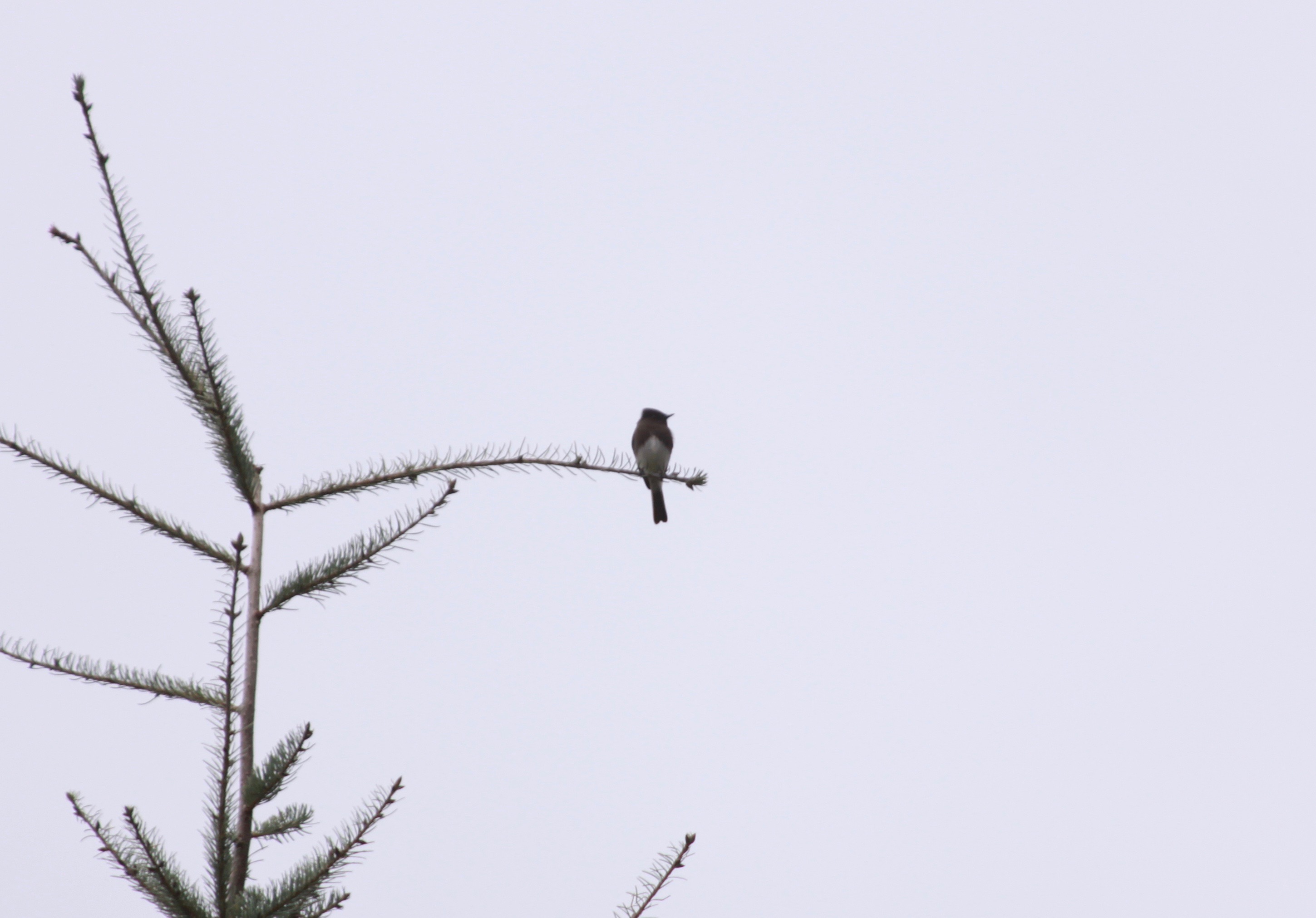
Late last year, I began encountering a surprising bird on my jogs, and the sightings carried over into this year, giving me the opportunity to add the black phoebe to my list of birds identified in each year.
Historically, black phoebes have avoided the Pacific Northwest in all seasons, preferring the warmer climate farther south. In fact, the fist place I ever saw one was in San Diego. However, as the planet has warmed, the species has moved north. Some individuals even winter over in the PNW. For example, I saw one in western Washington in December 2021 during an especially cold and snowy spell.
Having seen a black phoebe in Washington before, I wasn't totally surprised to see one in November 2023. What stood out about this specimen was how long it stayed in the area. Starting on December 24, I saw it on every jog for six weeks. At first, I'd go out jogging and wonder if I'd see the bird. Then, the sightings became so reliable, I would jog with the anticipation of seeing the streak extended another day. Finally, on February 5, I didn't see it, and I've only seen it once since then. Still, the streak was fun while it lasted, and it allowed me to put the bird on my yearly list for both 2023 and 2024.In a world changed by global warming, sightings of black phoebes in the PNW might become common, but I will always consider it a special memory how this individual visited in the cold months of the year.
31 December 2023
A Friendly Reminder
When I heard the news that Forterra had helped conserve a Girl Scout camp in Grays Harbor County, I thought to myself, "I know that place!"
Sure enough, Camp Klahanee, for which Forterra recently purchased the conservation easement, is the camp I was invited to visit by my cousin's Girl Scout troop in 2006. The news of the purchase brought back memories of my trip to the camp and why I had been invited there in the first place.
In late 2005, at my cousin's request, my mom and I gave a presentation to the troop about Finland. It was a fun evening as we shared information about the country and our experiences there. The next summer, the troop invited us to Camp Klahanee as thanks for our presentation. Set in a forest, the camp is beautiful and quiet. We had a great time at the troop's picnic.
As the Forterra press release explains, "Klahanee" means "friendship" in the Chinook language. Thus, the news was a friendly reminder of some happy experiences from the past and of the importance of conserved land in providing space for community building. Through a partnership with the Polson Park and Museum Historical Society, Forterra has ensured that Camp Klahanee will continue to serve as such a space.
A reminder that our environment offers us opportunities to grow and connect is a great way to end one year and look ahead to another.
30 November 2023
Something's Missing, Something's Wrong: A Fishy Situation
Something's missing in Washington state this year. More specifically, lots of fish are missing.
Historically low numbers of coho salmon and wild steelhead have returned to Washington's coastal streams in 2023. The Quinault Indian Nation reported low catch numbers for coho salmon in October. Then, on November 27, officials with Olympic National Park announced low numbers of wild steelhead in their rivers.
These numbers point to serious problems for both fish and people. As the runs of these fish continue to decline, they face the possibility of collapsing. At the very least, the low numbers from rivers that once teamed with salmon and steelhead indicate a distressed ecosystem. Such distress will impact people who depend on the fish for sustenance and their livelihoods.
In response to the troubling numbers, the Quinault Indian Nation closed its fisheries in Grays Harbor and on the Queets River. Olympic National Park took a similar step by closing the Queets, Salmon, and Quinault rivers to steelhead fishing.
With so many fish missing from Washington's rivers, something's definitely wrong in the Pacific Northwest.
30 September 2023
Five Months of Summer
Rain and cool temperatures returned to western Washington this week for the first time since April.
After falling in substantial amounts in April, the rain suddenly shut off when the calendar turned to May in the Pacific Northwest. Temperatures suddenly jumped up too with multiple 90-degree days recorded by the middle of May.
The usual rains of May and early June never materialized. It was as if summer had started two months early. Despite cooler temperatures in part of July, the dry spell continued. Even when rain was in the forecast, we hardly received more than a misting. Eventually, the summer weather reached nearly five months before real rain returned on September 23.
Together with the nearly four months of heat and dry conditions that stretched from July 2022 to late October of last year, this year's five-month summer meant that eight and a half of the last 15 months in western Washington have felt like summer conditions.
How much longer can summers like this go on?
29 April 2023
Howling Successes
The Washington Gray Wolf Conservation and Management 2022 Annual Report revealed some howling successes when it was released earlier this month by the Washington Department of Fish and Wildlife (WDFW).
First, the report showed continued growth in Washington state's wolf population. The state population grew to 216 individuals, an increase of five percent from its 2021 levels. This marks the 14th straight year of growth.
Significantly, despite the increasing wolf population, the number of livestock-depredation incidents was very small. Just seven packs (19 percent of the state's 37 packs) engaged in livestock depredation, and only three of those seven were involved in more than one incident. A total of 15 cattle and two sheep were confirmed to be killed by wolves. WDFW cites the "implementation of proactive, nonlethal deterrence efforts," including range riders, as a key to limiting depredation.
The formation of a pack in the southern Cascade Mountains represents another cause for celebration. It's the first pack in that region since wolves were driven to extinction in the state during the 20th century. Hopefully, it is an important step in the return of wolves to western Washington.
It's music to my ears to hear news like this report.
28 November 2022
A Fall of Two Weeks
Fall lasted for about two weeks in western Washington this year.
The summer weather of high temperatures and smoky air continued through October 20. By then, the land was bone dry and the vegetation ready to flame up like tinder. Coniferous trees had begun dying off due to a lack of water. As for the deciduous trees, unless their leaves had dried up or dropped because of the drought, they remained green far into October, giving few signs that the calendar had turned to fall.
On October 21, rain finally arrived. The temperatures slipped into the 50s, and the deciduous trees began to change into their autumn colors.
The fall feeling didn't last long though as temperatures declined abruptly. A November 2 storm even dropped snow at Lake Crescent (elevation 580 feet) near Port Angeles on the Olympic Peninsula less than three weeks after the October 16 record temperature of 87 hit Seattle.
Such a sudden shift from summer to winter has left many areas without green grass. In a normal year, fall rains would push up green shoots to replenish the grasses that go dormant and turn brown in the dry months of July and August. This year, the rain came so late that much of the grass had barely started growing again before the cold temperatures arrived to discourage further growth. Consequently, many fields and prairies remain brown.
It was a short fall to say the least.
20 October 2022
Lost in a Place I Know
I know where I am, but I don't recognize this place.
Never in my life have I seen an October in Washington state like this one. Summer will not let go, and hardly a hint of fall has presented itself. Seattle recorded its latest day of 85+ degrees on October 16 by reaching 88, one degree shy of breaking its all-time October high temperature, which was set on October 1, 1987, more than two full weeks closer to summer.
Perhaps the most disorienting factor comes from the constant presence of wildfire smoke. For the second time since September 2020, Seattle and Portland, Oregon, have the worst air quality in the world because of wildfires. Socked in for days on end, the smoke has defined this October as it had done to August and September in recent years. Today, even despite rain, the smoke would not relent.
Once one of my favorite months, the Pacific Northwest October has become an alien experience. It's hard to make sense of it.
Something's been lost here, and now, I am as well.
27 August 2022
Hot No Matter What
When the Pacific Northwest set all-time temperature records in June 2021, it did so following one of the driest springs on record, so in that sense, the records weren't a huge surprise.
In 2021, summer seemed to start at the beginning of April, giving the temperatures nearly three months to heat up to 110 degrees or more in late June.
The spring of 2022 presented a clear contrast to its predecessor though. Wet, cool weather carried into the middle part of June, bringing to mind springs of 20 or 30 years ago.
Still, the last part of June provided indications that the weather of spring might not hold back summer's high temperatures. From June 25 to June 27, temperatures shot up suddenly, approaching and even surpassing 90 degrees.
Cool weather returned for a couple of weeks to start July. It even brought a little rain around the Fourth of July, again harkening back to the trends of earlier decades.
Then, starting on July 26, an unprecedented stretch of 90-degree weather gripped the Pacific Northwest. For the first time in recorded history, Seattle experienced six straight days that reached at least 90 degrees. The previous record was five straight days of 90-degree weather. It had been achieved three times, most recently in 2015, a year that like 2021, had begun heating up and drying out early in the spring.
In light of 2021's heat, this year's record fits into a larger trend. That the 2022 record came out of a year that had been relatively cool (by recent standards) gives it its own alarming reality though.
The fact is that extreme heat is becoming so common in the age of global warming, it requires hardly any lead-up to take hold and set new records.
17 July 2022
Connections and Relationships
Building connections and relationships has always been crucial to social causes. Its importance continues to grow as the bonds linking society fray and rupture.
In its efforts to undertake conservation projects in southwest Washington, which I previously blogged about here, Conservation Northwest is taking steps to ensure such connections and relationships have strong roots.
On July 20-22, the nonprofit organization will co-host the Southwest and Coastal Washington Connectivity Summit. The summit will bring together nonprofits, tribes, government agencies, land owners, and businesses to lay the groundwork for future efforts to ensure habitat connectivity and address ecological issues like global warming. This will be the first summit on these issues in southwest Washington, but the plan is to continue holding them every two years.
This year's event is in Ridgefield, Washington. However, it can also be attended virtually.
I'm very excited to see the potential of the relationships that come out of these summits.