Showing posts with label Black Hills Audubon Society. Show all posts

24 January 2022

Double Coverage

Maybe it was all the twos in 2022, but when this year began, my management of the Facebook page for the Black Hills Audubon Society hit a fitting milestone.

On May 22, 2019, I started managing the page. At that time, it had amassed 364 followers in a little more than seven years. By January 1, 2022, that number had doubled to 728.

To add to the excitement, January 2022 has given the page a good start toward the next 364. Already this month, the page has 21 new followers.

The growth during the last 32 months means a lot to me. It is great to see my work having an impact, and it is equally satisfying watching the organization's Facebook coverage expand.

You could say it's twice as nice when achievements like this go toward a good cause.

20 February 2021

More Birds of a Feather

Facebook pages of bird-watching groups don't have followers; they have flocks. And the flock following the page for the Black Hills Audubon Society (BHAS) grew a lot last year.

In 2019, I started managing the BHAS Facebook page. As I reported last year, the page saw some encouraging results in the first eight months.

I am happy to report that the trend continued in 2020. From February 1, 2020, to February 1, 2021, the number of followers went from 472 to 619, an increase of 31.1 percent. Furthermore, from my first day back on May 22, 2019, the followers have increased 70.1 percent. Page likes show similar trends, increasing 29.5 percent (417 to 540) from February 1, 2020, to February 1, 2021, and 57.4 percent overall from May 22, 2019.

Despite having fewer birding events in 2020 because of COVID-19, the BHAS Facebook page continued attracting attention. I am proud of the results and look forward to continued growth in 2021.

I'll do my best to keep people flocking in.

22 November 2020

Birding Field Trips: A How-To Guide

"Field trip!" Remember those two magic words from school? 

Now, thanks to the Black Hills Audubon Society (BHAS), it's possible to recapture the power of field trips, and this time, you get to pick your destination. Meanwhile, you can experience some first-rate bird-watching. 

Because of the need to social distance during the pandemic, BHAS canceled all of its guided birding outings for the foreseeable future. However, the organization remained committed to giving people opportunities to see birds, introducing do-it-yourself (DIY) field trips. 

To foster DIY birding, BHAS began sending out scouts who report back from various birding locations in southwestern Washington. These reports give people all the information they need to know about how to access the locations, what to do while there, and which birds have been seen there recently. By taking the place of a human guide, the scouting reports allow people to continue birding the places BHAS frequents under normal circumstances. To access the reports, click here.

After you find a location you'd like to visit, you can even yell, "Field trip!" if you feel like it.

16 May 2020

Reflecting on 10 Years of Blogging

What do you do after you have to create a blog for a class assignment and that class ends? If you're a tree-hugger with Finnish heritage, the obvious answer is to retitle it envirofinn and write about the environment for at least 10 years.

For the 2010 spring semester of my Ph.D. studies, I had to start a blog in my rhetoric class. It was simply a blog about assigned readings. Since I didn't have any more of those after the class ended, I decided to take the blog in a new direction on May 19, 2010. I thought it could become a good place to collect and share information about the environment.

Looking back on the last decade of envirofinn, I realize how much I put into its development and maintenance. It turned into a lot more than an information hub. I liked the template I chose so much, I haven't changed it once despite having many new options. The fall theme is just too me. Plus, I think it still looks nice. Besides, I spent a great deal of time trying to find the perfect color scheme for the text, and when I finally found it, I didn't want to let it go. I'm also quite fond of the envirofinn flag I created by adding the green of the blog to the Finnish flag.

A lake in Repovesi National Park reflects
a partly cloudy sky over Finland.
Yes, a lot of myself went into this blog. Eventually, the posts evolved from sharing resources, tips, and events to covering some of my personal experiences and growth as well. A few highlights included going to Finland in 2012 and coming back with material for several posts and the series from summer 2015 that chronicled my coming to terms with the age of global warming.

Some posts also recorded professional accomplishments and development. For instance, I used the blog to announce that I had published a journal article about environmental communication. In addition, I covered my work with Initiative 1631, Carbon Washington, The Nature Conservancy in Washington, and the Black Hills Audubon Society. In short, envirofinn contains some major pieces of my life even though it continues to be a place where I share resources, tips, and events. It probably helped me further my understanding of the environment as much as it helped anyone else learn where to recycle something or how to buy reusable shopping bags.

One thing I take extra pride in is the fact that I have made at least one post in each of the last 120 months. I may not post as often as I once did, but it remains important to me to keep the streak going.

A lot has happened since its inception, but looking toward the future, envirofinn will continue exploring our connection with the environment.

26 February 2020

Taking Flight

After a few practice flights, my work managing the Black Hills Audubon Society's (BHAS) Facebook page has begun to take off in earnest.

When I started the work for BHAS last May, I blogged about it here. During the course of the ensuing nine months, I tried a few different things to engage and increase the organization's followers. Starting with 364 followers, I saw a small increase initially, but as I fine-tuned my strategies for making posts, the follower totals and the engagements began to soar.

November represented the point at which everything started to come together. The daily reach of posts dwarfed the rate seen earlier, going from 27 on January 1, 2019, to a current high of 377 on February 10, 2020, (see Graph 1). Likewise, the number of people viewing the site jumped up, particularly when it came to people viewing the homepage and scheduled events (see Graph 2). Paralleling these trends, the number of followers saw a marked rise. Currently, the page has 484 followers, an increase of nearly 33 percent in nine months. What's more, all of those growth points coincided with an uptick in people attending the organization's events, and many of those individuals credited the Facebook posts with bringing them there.

The successes on the BHAS Facebook page have also brought two intangible results. First, I have thoroughly enjoyed doing the work. It's a great combination of strategy and fun. Second, because of the measurable results in followers, engagements, and event attendance, managing the page has been very fulfilling. I can see the impact of my work and know that it's helping a great organization.

Stay tuned to see how high this project flies.


08 November 2019

By Necessity, By Design, By Me

Some things don't go exactly like they are drawn up, and some things do. In the case of my work for the Black Hills Audubon Society, both are true.

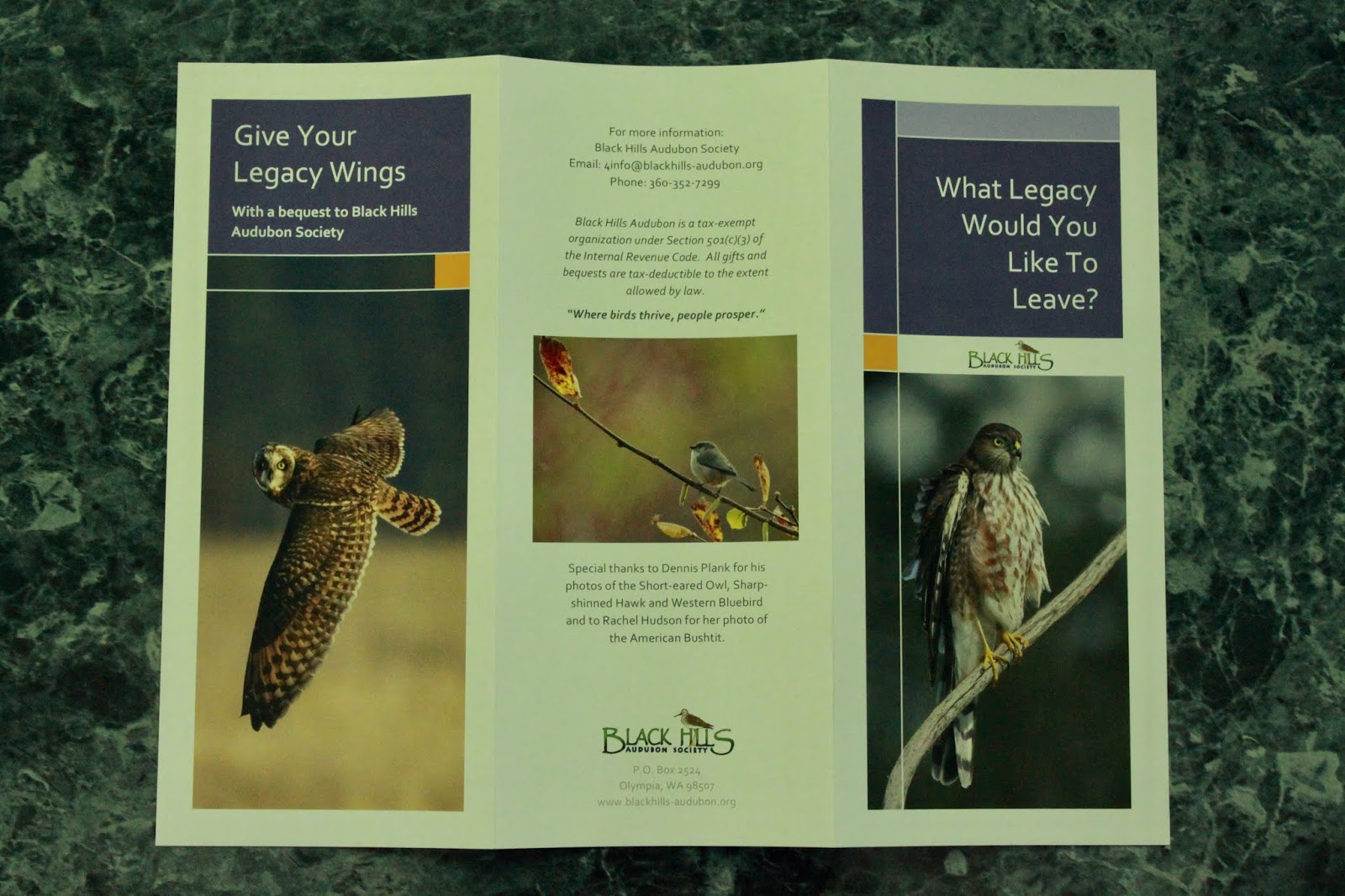
When I started helping the Black Hills Audubon Society in May, my duties focused on managing the organization's Facebook page. That's gone well. However, a new twist developed in August when the organization sent out a call for help on an upcoming brochure. I'd done some layout projects and worked with graphic designers before, but I had never created a brochure on my own, so I offered to help on this project if the organization couldn't find a professional graphic designer who would work for free.

A look at the brochure I created for
the Black Hills Audubon Society.
Necessity took over when Black Hills Audubon couldn't land a pro. I was it, so they turned to me, and I turned my attention to figuring out what I needed to do. Before I met with them to discuss the project in detail, I created a rough sketch of a simple trifold brochure. My goal was to tell a visual story with the images guiding the reader's eye. Slightly to my surprise (after all, I wasn't a layout expert), they liked it and turned me loose with their only request being that I use a Microsoft Word template, a stipulation that made my design work a bit easier.

That rough sketch proved an effective guide. Using the photographs and text Black Hills Audubon provided and a brochure template I thought worked well, I implemented my vision. By the time I sent out a draft for comments, I started feeling considerable excitement and pride about the product. It just looked good! At least, I thought it did. Still, I was again a little surprised when they agreed with my assessment without requiring any major changes. They were happy, and that made me even happier.

When I received copies of the finished brochure, I couldn't help but smile. There it was: My vision, my design, and my work, all derived from necessity, smoothly developed, and successfully executed.

Back in May, I didn't know my foray into managing a Facebook page would lead to designing and laying out a brochure, but I am glad for the challenge and the chance to put my stamp on this project for Black Hills Audubon.

30 August 2019

First Sight and Further Reflection

A brown pelican fishing a Moclips.
One of the birds I saw on a recent trip to the beach took me about a second to identify; another bird required a couple of days and input from two other birders.

As I walked toward the ocean at Moclips two weeks ago, I saw the unmistakeable profile of a brown pelican flying down the beach. Just like that, I had added to my 2019 birding list.

Later, while wading at the waterline, I added to the list again. This time though, I wouldn't know for sure that I had added to it until more than 24 hours later. That's because the second identification was difficult. Among a group of western sandpipers and least sandpipers, I saw a strange interloper. Like the other two species around it, this bird was a smallish shorebird, but it was slightly larger than the others and had distinct plumage. I took some pictures of it for later identification.

An early-arriving sanderling.
The pictures didn't help much even when I consulted my field guides or online sources like All About Birds. Finally, I sent a picture to a contact at the Black Hills Audubon Society. She guessed it was a sanderling but wasn't sure because the pattern on its breast was a bit unusual, so she sent the picture to another birder, who confirmed it was a sanderling. Besides having slightly different plumage, the bird was also an early arrival on its migration and marked my very first sighting of the species; so the identification was definitely worth the wait.

Whether I know it at first sight or need further reflection to identify it, any bird is a fun and rewarding addition to my birding list.

23 May 2019

New Horizons on Feathered Wings

From scholarship to writing and public relations, I've done a lot of work in communication, but starting today, I have the opportunity to do something new.

A yellow warbler I photographed on a recent outing
with the Black Hills Audubon Society.
Despite my time in public relations and my experiences teaching best practices for using social media and even employing Twitter and Pinterest as teaching tools in my classes, I have never managed an organization's social media. That changed today when I started managing the Facebook page for the Black Hills Audubon Society (BHAS).

Envirofinn reflects my affinity for birds. Many of the posts focus on bird-related topics, including my successes in bird-watching during the last few years. On one occasion, I even blogged about a birding event BHAS led. The organization does a nice job of making birding fun and accessible, so when they put out a call for help with their Facebook page, I didn't hesitate to offer my time.

With my background in communication, I can help promote BHAS's events and overall presence. In return, I now have the chance to use social media strategically for a topic I love. I couldn't wait to make my first post, which went up this morning. If you'd like to keep up with the posts and what BHAS is doing, click here.

When looking for new horizons, follow the birds.

26 September 2018

Sandhills and Mountains

I saw four volcanoes yesterday, and they weren't even the biggest sightings of the day.

One of the sandhill cranes that flew over as I walked the
Kiwa Trail at the Ridgefield National Wildlife Refuge.
The drive to and from the Ridgefield National Wildlife Refuge had views of Mount Rainier, Mount St. Helens, Mount Adams, and Mount Hood. That, by itself, is enough to make a day remarkable. At the refuge, however, I logged my very first sighting of sandhill cranes, turning remarkable into breathtaking.

Yesterday's spectacular views began to take shape several weeks ago when I visited the Web site of the Black Hills Audubon Society. They had planned a trip to the refuge at Ridgefield with the hope of seeing some sandhill cranes. Previously unaware that the cranes visited the refuge, I became interested in making my own trip there. With birders reporting sightings of the cranes at Ridgefield over the weekend and with sunny weather coming this week, I made up my mind to go. I'm so happy I did.

Mount St. Helens watching over the
Ridgefield National Wildlife Refuge.
On the drive to Ridgefield, a haze shrouded the Cascade Mountains, hiding Mount Rainier, but the three volcanoes to its south proudly made their appearances as my mom and I neared our destination. The towering giants served as an exciting prelude to what the refuge had in store for us. We heard the sandhill cranes before we saw them, and then, after photographing a green heron and some cedar waxwings at the beginning of the Kiwa Trail, we sighted our first group of cranes about a third of the way down the trail. Never having seen a sandhill crane in person before, I felt like I had just discovered some priceless artifact. As we continued down the trail, another group of cranes flew over head, we saw a great egret, and Mount St. Helens peeked over the hill. We had amazing sights all around, and at the center of it, I found those cranes and the sense that they had given me an experience everyone should have at some point in life. Something special exists in those birds, a charisma and a power that compels us to take notice.

Before leaving the refuge, we also saw a pied-billed grebe. After lunch in Ridgefield, we began our return trip. Mount St. Helens, Mount Adams, and Mount Hood remained out for viewing, and Mount Rainier finally presented itself.

Four volcanoes, three birds added to my 2018 list, which now stands at 124 species, and, to top it all off, my first sighting of sandhill cranes: a day to remember for sure.

21 May 2017

Early After All This Time

The Glacial Heritage Preserve and the Black Hills
on Prairie Appreciation Day 2017.
The seemingly contradictory claims that "good things come to those who wait" and "the early bird gets the worm" came together at the Glacial Heritage Preserve in southwest Washington state last week to make one special experience.

Every year in early May, the preserve opens to the public for Prairie Appreciation Day. Offering wildflowers, educational booths, and a chance to catch up on all the work done to protect the important prairie environment near Puget Sound, the event celebrates spring and environmental preservation.

My mom and I used to go before I began my doctoral studies, but because of school and work commitments, I've had a long wait between chances to enjoy Glacial Heritage. Last year, I stopped in for the first time since 2008, but I could only stay for about 30 minutes. To make things worse, most of the wildflowers bloomed out before Prairie Appreciation Day last year because of an abnormally hot April.

My long wait to immerse myself in the prairie ended this year on May 13 though, and thanks to the Black Hills Audubon Society, I made it to the prairie before almost everybody else and before the rain. Most of the day's festivities began at 10 a.m., but the Audubon Society hosted a birding event at 7:30 a.m., giving those who participated early access and an exceptional experience of the preserve.

As I walked with the other birders, I reacquainted myself with the prairie in a whole new way. With the wildflowers in full bloom this year, the morning sun glistened off fields of wet camas, blue-eyed Mary, and golden and harsh paintbrushes. Years of restoration work, which still continues, showed in the colorful, lively landscape.

In the middle of this sea of flowers and Mima Mounds, birds sang, chattered, buzzed overhead, and landed on the informational signs set up for the public. I had never birded the prairie before, and the group of birders helped me identify three species I would not have confirmed on my own. Two (the willow flycatcher and the western wood peewee) proved quite difficult to distinguish without great expertise, and the third (an orange-crowned warbler) was only identified by its song, which I wouldn't have known by myself.

All told, the birders received three hours of good birding before the rains came at 10:30 a.m. As the majority of people were just arriving, we walked out having seen more than 40 species. Personally, I added eight new species to my 2017 total, and I left with a special feeling of having seen the prairie again after a long absence and before most everyone else this year.

My 2017 Prairie Appreciation Day proved that the early birder gets the good weather and a memorable experience even if it means waiting nine years.